The House That Held Its Breath . . .
And Then Exhaled
A 21-day sprint to the finish line, a grandson who appeared from nowhere, a crystal healer who rang the doorbell at exactly the right moment. The story of how Casa Fuzetta came alive — and what happened the day the furniture arrived.
There is a particular moment in any building project - if you are paying attention - when the thing stops being a project and becomes a place.
When the dust settles enough to see what you have actually made. When it exhales.
For Casa Fuzetta, that moment came in June 2016, at the end of a sprint so improbable that the people who lived through it still aren’t entirely sure how they did it. Three years of work. Three derelict buildings in Olhão, the working fishing town in the eastern Algarve that most visitors to Portugal drive straight through. A race to the finish line that left no room for doubt - only trust.
This is the story of what happened when the house finally opened its doors.
Twelve Months, Squeezed Into Six
By January 2016, the restoration of Casa Fuzetta was two years in. The architects were excellent. The town hall had been, by all accounts, extraordinarily supportive - the lead architect, a man with 25 years of experience, said he had never in his professional life seen a local authority offer that kind of backing to a project. Even he attributed it to something like a guardian angel.
But the timeline was slipping. What everyone said would need at least twelve months more, Tara had six to deliver. Because Tod, her husband, the dreamer who had first spotted the building and envisaged it as a place of spiritual retreat, had already issued invitations. A group was coming. There was a date. There were beds that needed to be made, bathrooms that needed to work, a kitchen that needed to be ready.
Tod, it should be said, was not heavily involved in the details. Tara describes him as a big-picture thinker, not a detail person. He had a tendency to wander away from the few project meetings he attended to go explore the house and poke his head out of random windows instead. This habit, as it turned out, would lead to one of the most extraordinary moments the house has yet to witness.
Nothing like a deadline. I called in the chips. Get everybody off the other projects. We need to finish this!
With weeks to go, Casa Fuzetta had sixty people working on site simultaneously. One day, articulated lorries arrived carrying furniture, including pieces from Tara’s great-grandparents’ storage that she had never seen, with no photographs and no dimensions. The lorries were too large to navigate Olhão’s narrow cobbled streets, so everything was offloaded into a smaller van and then piece by piece, passed through the one, small front door that was then ready for use. Each piece had to be unpacked at speed and placed across the house before the next delivery arrived. Every piece was placed in that one day.
Not a single piece has been moved since.
Tara had put together a spreadsheet in advance, mapping where everything would go. On the day, running on instinct and something harder to name, she called it all in real time. Antique chests were balanced on a cherry picker and passed in through upper-floor windows by hand. Cardboard was thrown out onto the street below. The neighbours, who had been extraordinarily patient through two years of construction noise, bore this final day with characteristic grace.
And then it was done. Building site to functioning retreat: 21 days.
The Grandson Who Appeared at the Window
A few months before the doors opened, Tod was doing what Tod does, wandering around the house, head in the clouds, having exited a project meeting within five minutes of it starting. He was on the first floor, looking down from a window onto the street below.
An older couple was standing there, looking up. With them were three young men, their grandsons, visiting from Brazil. The grandfather called up.
“Is this your house?”
“Yes.”
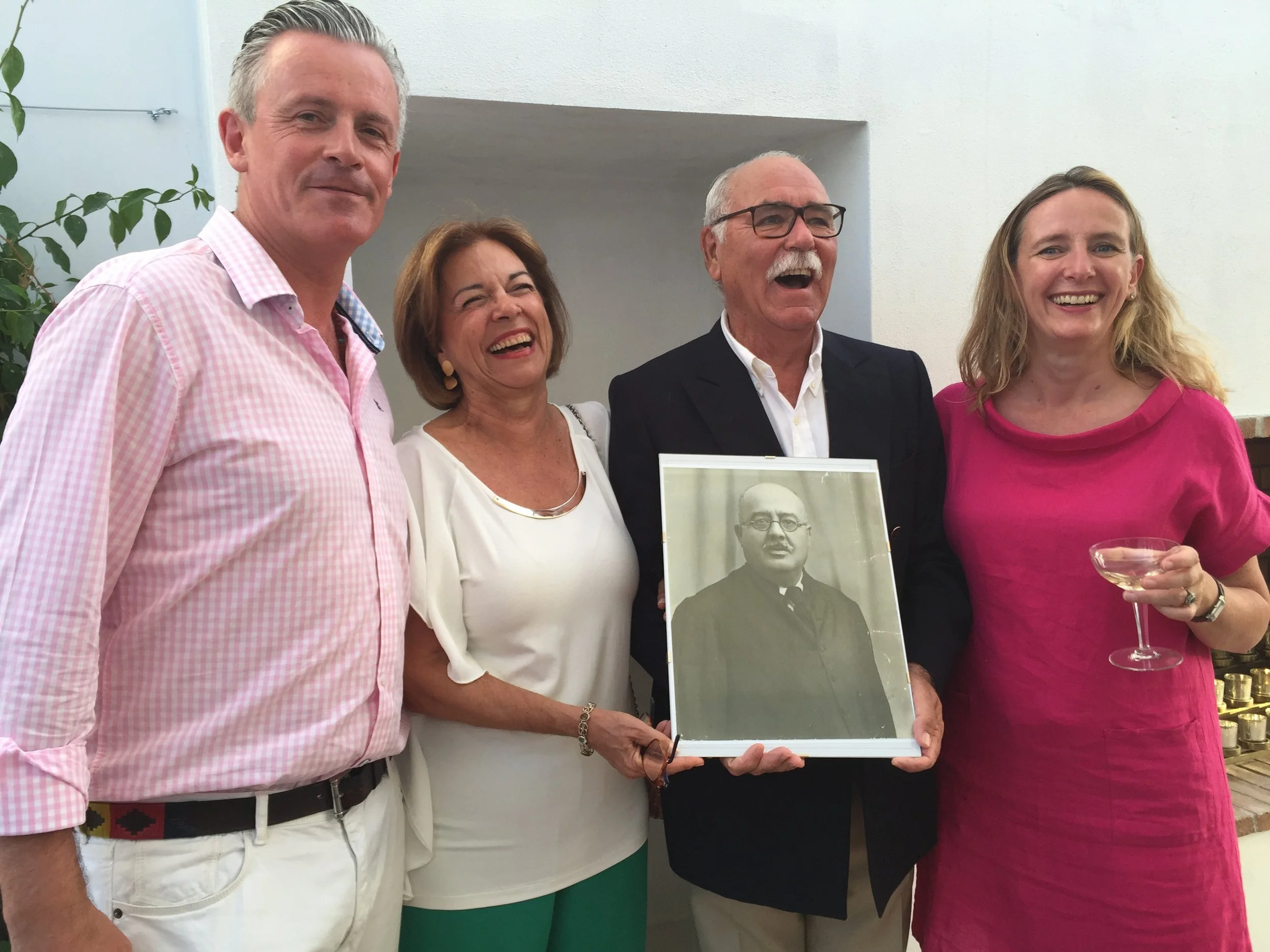
“I am the grandson of Carlos Fuzeta. I unveiled that plaque when I was seven years old.”
The plaque on the facade of Casa Fuzetta bears the name of Dr. Carlos Fuzeta: lawyer, advocate for the rights of the local fishermen, philosopher and philanthropist. The man the house was named for. The man whose values, without either Tara or Tod quite knowing it when they first stood in front of that plaque in 2013, had drawn them to the building in the first place.
The grandfather had not been to Olhão in over thirty years. He and his wife lived in Lisbon. The grandsons, visiting from Brazil, had begged to see the house they had heard so much about. It was a passing moment - a family walking by on a weekday afternoon - that became something else entirely.
There was not a dry eye in the building on the day they all met.
When the house finally opened that June, the Fuzeta family were invited back as guests of honour at the inaugural dinner on the kitchen terrace. The baton, as Tara puts it, was passed.
The People Who Arrive Exactly on Time
Casa Fuzetta has a habit of producing this. Not coincidences, exactly, or not only coincidences. More like a series of arrivals that make sense only in retrospect, when you see how perfectly each one fitted the gap that just opened.
In the weeks before opening, Tara needed a house manager. She had found someone perfect: English, fluent in Portuguese, lived two streets away, had run chalets for multiple seasons. Then, one week before Tara flew out for the final push, the woman called to say she had decided she wanted to work with animals instead.
Tara, who had been running on a mantra of trust since leaving her role as CEO of Jamie Oliver’s media group, took a breath and let it go.
Trust. That had become the whole mantra for the project. And the universe tends to respond to that.
The following day, Claudia - someone Tara had already met and thought perfect for the role but had been told wasn’t available full-time - sent a message. The other job wasn’t working out. Was the position still open? Problem solved?
Not quite.
Claudia needed to serve three months’ notice. Yet the day after that piece of news came in, a chef from the building team rang the doorbell and introduced a second Claudia: a crystal healer, fluent English speaker, available immediately, looking for three months of work.
The gap was filled. Both Claudias, in sequence, exactly when needed.
This is the pattern. The right person, with the right skill, at the right moment. It happened with the architects, found through a friend-of-a-friend connection, two degrees of separation from disaster. It happened with the builders, who rallied to finish in three weeks what should have taken twelve months more. And it happened with the community of Olhão itself.
A Town That Was Waiting
The older generation of Olhão knew the building well. When electricity first came to the town, the house served as the offices of the local electricity board; people came there to pay their bills. Some had lived in it. Others had played in it as children, or had cousins who had. When the restoration began, locals would give small thumbs-up signs to Tara in the street. Some sneaked in through the building site when the builders left a door open, just to have a look.
Years before Tara and Tod arrived, a group of local residents had successfully petitioned for a protection order on the building after a developer tried to convert it into a block of flats. The community had already decided the house mattered.
What Casa Fuzetta gave back, as Tod had always intended, was energy rather than extraction. Something that benefited the town, employed local people, and added to Olhão rather than taking from it.
The Painting in the Library
Before the house opened, it needed a website. Before the website, it needed photographs. And before the photographs, it needed to look like somewhere - dressed, styled, alive.
Aaron, a creative director from Toronto, on sabbatical in Olhão with his partner David (the two of them would go on to found Casa Cubista, a homeware brand that is now sold from Paris to New York and has been knocked off in the souks of Morocco — a sure sign, Tara notes, that you’ve made it) came in and shared twenty years of experience in two days, teaching Tara the language of interiors photography and styling.
The rule they kept returning to: interiors photography hates an empty space.
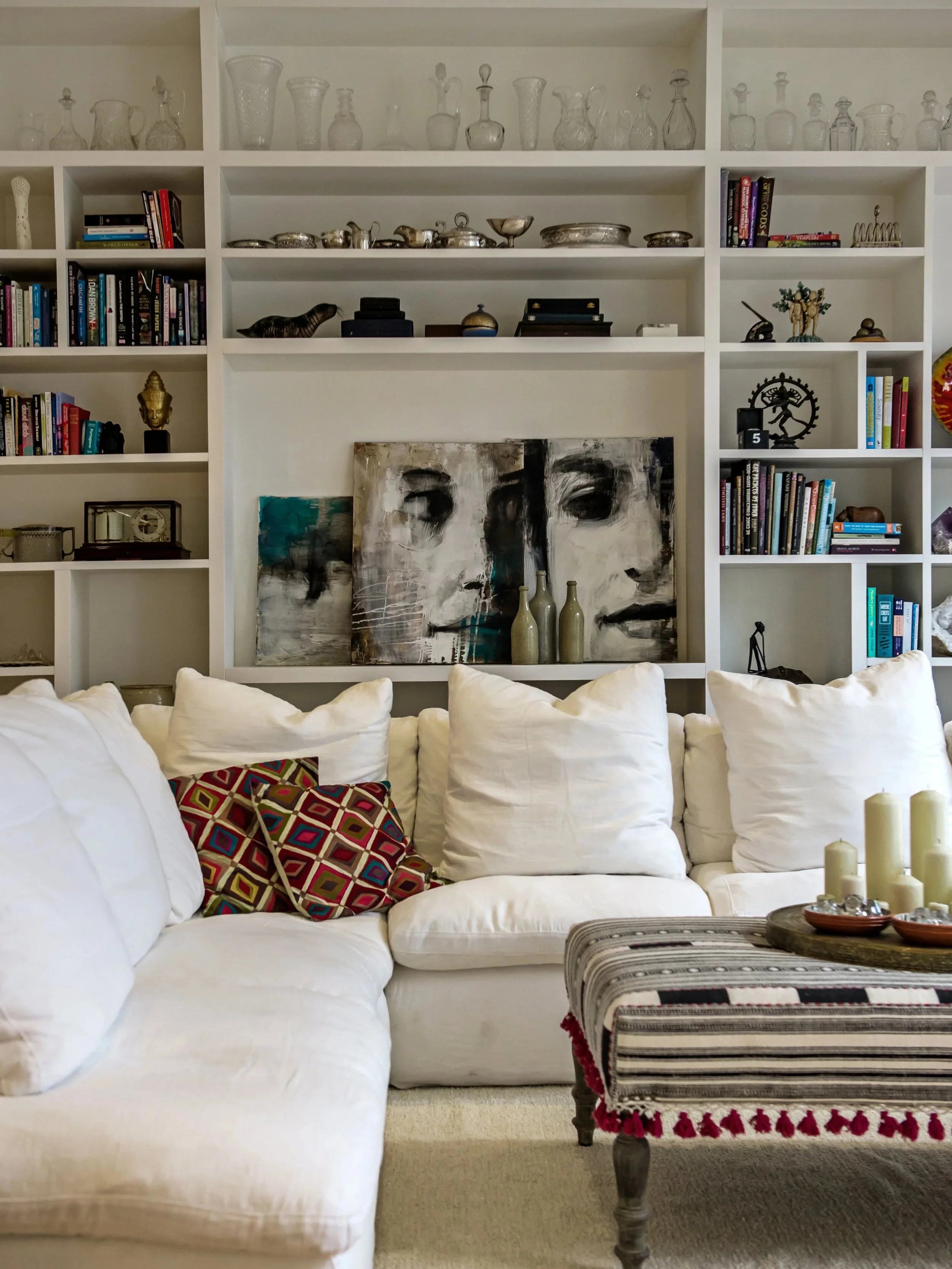
The library at Casa Fuzetta has a great deal of shelving. They filled it. But there remained, slap in the middle of the wall, a large rectangular gap. It was the right scale for a painting, but there was no painting.
The night before, Tara had been at dinner with Meinke Flesseman, a Dutch artist who had been living in Portugal since her parents drove down in a camper van when she was five and never quite made it back out. Tara called her. Could they come over with a tape measure?
They went through the gallery. Nothing fit. They went through the house. Nothing fit. Finally, in a ramshackle studio at the back of another building - round the corner, as it turned out, from Casa Fuzetta itself - Tara spotted something green in a back corner. Three panels. Together they were the right size. They carried them back and propped them in the space.
Perfect. Meant to be. A loan because the first of Casa Fuzetta’s now growing collection of art by Meinke.
A few months later, a travel journalist, nicknamed by Tara “Mrs. Portugal” came to visit the house. Standing in the library, Tara told the story of the Meinke portraits. The journalist stopped her.
Her husband had commissioned Meinke to paint a family portrait as a surprise for her 40th birthday. She had never met the artist. Yet Meinke lived two streets away.
They went immediately. In the gallery, the conversation turned to where Meinke had been when she painted the library pieces. A place called Vézelay, in France.
This time it was Tara who was stopped in her tracks. Vézelay is a medieval pilgrimage town southeast of Paris, the starting point for one of the Crusades.
It was also the base for the first pilgrimage / sacred journey Tara had agreed to join Tod on.
The paintings in the library were made in the same place, on the same trip, as the one now hanging in the living room. They had found their way to Casa Fuzetta without anyone planning it.